
Knee Replacement Surgery Cost in Mexico: 2026 Prices (Save 70%)
Table of Contents
- Comparing Knee Replacement Surgery Cost in Mexico vs. The US
- A Detailed Breakdown of Knee Surgeries Prices in Mexico's Top Medical Tourism Cities
- Why is the Surgery Cost in Mexico So Affordable?
- Planning Your Trip to Mexico for Knee Replacement Surgery
- Frequently Asked Questions about Knee Replacement in Mexico
Suffering from knee pain and shocked by US surgery prices? This guide reveals how you can save 70-80% on high-quality knee replacement surgery in Mexico.
We'll break down the exact surgery cost for total, partial, and robotic procedures in top medical tourism cities, explain why prices are so low, and provide a step-by-step guide to planning your trip.
Comparing Knee Replacement Surgery Cost in Mexico vs. The US
When you're facing chronic knee pain, the financial burden can feel just as overwhelming as the physical discomfort. The cost of knee replacement surgery in the United States has reached staggering heights, leaving many patients with an impossible choice: live with debilitating pain or face potential bankruptcy.
Here's where Mexico changes the game entirely.
By crossing the southern border, patients discover that world-class orthopedic care doesn't have to drain their life savings. The price difference isn't marginal. We're talking about savings that can fundamentally change your financial situation while getting you the surgery you desperately need.
Complete Knee Surgery Cost Comparison Table (Mexico vs. US)
| Procedure | Average Cost in Mexico | Average Cost in the US | Potential Savings |
|---|---|---|---|
| Total Knee Replacement | $7,000 - $15,800 | $30,000 - $50,000 | ~80% |
| Partial Knee Replacement | $9,500 - $12,500 | $20,000 - $40,000 | ~70% |
| Bilateral Knee Replacement | $22,500 - $25,000 | $60,000 - $100,000 | ~75% |
| Knee Arthroscopy | $3,500 - $7,000 | $15,000+ | ~80% |
These numbers tell a compelling story. A procedure that would cost you $50,000 in the United States can be completed for under $10,000 in Mexico. That's not a typo.
Even if you need surgery on both knees simultaneously, you're still looking at prices that barely touch what a single knee replacement in Mexico would cost back home.

How Much Can You Really Save on Orthopedic Surgeries?
The overall savings range between 70% and 80% when you choose Mexico over the US for orthopedic procedures. Think about what that means for your finances.
For patients without insurance or those facing high deductibles, these savings are immediate and tangible. There's no fighting with insurance companies, no surprise bills arriving months later, and no financial stress during your recovery.
The average cost of a total knee replacement in the United States hovers around $40,000. The same procedure in Mexico ranges from $7,000 to $15,800, depending on the city and facility you choose.
But the savings don't stop when you leave the operating room.
Post-operative medications in Mexico typically cost 40-60% less than in the United States. When you're recovering and need pain management or antibiotics, these reduced medication prices add another layer of savings to your overall medical expenses.
Similar to hip replacement surgery, knee procedures in Mexico maintain the same quality standards while offering dramatic cost reductions. The orthopedic excellence extends across multiple joint replacement procedures, making Mexico a comprehensive destination for bone and joint care.
A Detailed Breakdown of Knee Surgeries Prices in Mexico's Top Medical Tourism Cities
Not all Mexican cities offer the same prices or specialties. Understanding where to go for your specific type of surgery can help you maximize both savings and convenience.
Each medical tourism hub has developed its own strengths, attracting different types of international patients based on location, specialty, and pricing structure.
Comprehensive Price Table: Knee Surgeries in Mexico (City by City)
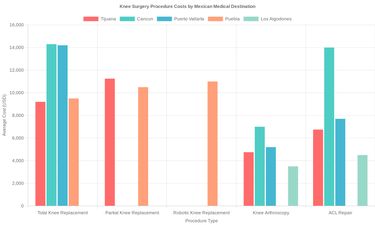
| Procedure | Tijuana | Cancun | Puerto Vallarta | Puebla | Los Algodones |
|---|---|---|---|---|---|
| Total Knee Replacement | $7,000-$11,400 | $12,800-$15,800 | $13,500-$14,900 | $9,500 | N/A |
| Partial Knee Replacement | $10,500-$12,000 | N/A | N/A | $10,500 | N/A |
| Robotic Knee Replacement | N/A | N/A | N/A | $11,000 | N/A |
| Knee Arthroscopy | $3,500-$6,000 | $7,000 | $5,200 | N/A | $3,500 |
| ACL Repair | $6,000-$7,500 | $14,000 | $7,700 | N/A | $4,500 |
Tijuana offers the most competitive pricing for most procedures, thanks to its proximity to the US border and high concentration of medical facilities. Patients from California, Arizona, and other southwestern states can drive across the border for treatment.
Cancun and Puerto Vallarta command slightly higher prices but offer the advantage of combining your medical recovery with a more resort-like environment. The beaches and tourist infrastructure make these cities attractive for patients who want family members to accompany them.
Los Algodones, despite being a small border town, has earned a reputation as the dental and minor surgery capital of Mexico. It's particularly strong for less complex procedures like arthroscopy and ACL repair.
For patients considering other complex orthopedic procedures, limb lengthening surgery is also available at competitive rates across these same medical hubs.
What's Included in a Package for Knee Replacement?
Mexican hospitals have perfected the all-inclusive package model. This approach eliminates the surprise bills that plague US healthcare, where you might receive separate invoices from the surgeon, anesthesiologist, hospital, and laboratory weeks or even months after your procedure.
Here's what you can expect in a comprehensive knee replacement package:
The core surgical costs cover everything essential. Your surgeon's fee, anesthesia services, and hospital stay (typically 2-3 nights) are bundled together in one transparent price. No hidden charges, no surprise fees.

High-quality implants from trusted manufacturers like Zimmer Biomet come standard in most packages. These are the same FDA-approved implants used in American hospitals. The knee joint components meeting the same regulatory standards you'd expect back home.
Pre-operative and post-operative care is comprehensive. Before surgery, you'll receive necessary blood work, imaging studies like X-rays or MRIs, and consultations with your surgical team. After surgery, your medications for the initial recovery period are typically included.
Logistics support makes the entire experience smoother. Most facilities provide airport pickup and drop-off, ground transportation between your hotel and hospital, and a dedicated case manager who speaks fluent English and coordinates every aspect of your care.
Initial rehabilitation sessions start your recovery on the right track. Physical therapy begins in the hospital, helping you learn proper movement techniques and exercises before you return home to continue your recovery.
Many patients also explore other surgical options in Mexico. For instance, gastric sleeve surgery in Tijuana demonstrates how the same city offers multiple specialties at dramatically reduced costs.
Why is the Surgery Cost in Mexico So Affordable?
This is the question that makes many people skeptical. How can prices be 70-80% lower without compromising quality?
The answer isn't cutting corners. It's economics.
1. Lower Operating Costs and Economic Factors
The cost of living in Mexico is significantly lower than in the United States. This fundamental economic reality cascades through every aspect of healthcare delivery.
Hospital rent, utilities, and support staff salaries cost a fraction of what they do north of the border. A nurse or administrative assistant in Tijuana earns a comfortable middle-class wage in local terms, but that salary is far below what the same position would command in San Diego, just 20 miles away.
Medical education in Mexico follows a different financial model. While American doctors often graduate with $300,000 or more in student loan debt, Mexican physicians typically face minimal or no educational debt. This means they don't need to charge astronomical fees just to service their loans.
Administrative overhead in the Mexican healthcare system is dramatically lower. There's no complex insurance bureaucracy requiring armies of billing specialists to navigate claim denials and authorization requirements. This lean administrative structure cuts costs substantially.
The healthcare system efficiency shows in international rankings.
According to NationMaster data, Mexico ranks #17 globally for healthcare cost efficiency, while the United States languishes at #41.
Similar cost advantages appear across various medical specialties. Whether you're seeking bypass surgery or cancer treatment, the same economic factors create substantial savings.
2. High Competition Among Hospitals for Knee Procedures
Medical tourism has created a highly competitive marketplace in Mexico's major healthcare cities. This competition benefits you as a patient.
Tijuana, Cancun, and Puerto Vallarta each host multiple world-class orthopedic facilities within close proximity. When hospitals compete for patients, prices stay competitive while quality rises.
These cities attract tens of thousands of international patients annually. The high patient volume allows hospitals to maintain profitability even at prices that seem impossibly low by American standards. Think of it like bulk pricing: higher volume enables lower per-unit costs.
To win your business, hospitals must offer transparent, attractive pricing without sacrificing quality. They can't rely on insurance company negotiations or opaque billing practices. They must compete on price, quality, and service, which creates an environment where patients get exceptional value.
Planning Your Trip to Mexico for Knee Replacement Surgery
Once you've decided that Mexico makes financial sense, the planning process becomes crucial. Choosing the right surgeon and facility can make the difference between an excellent experience and a problematic one.
Finding the Best Knee Replacement Surgeons and Hospitals in Mexico
Your orthopedic surgeon is the most important factor in your surgery outcome. Don't choose based solely on price.
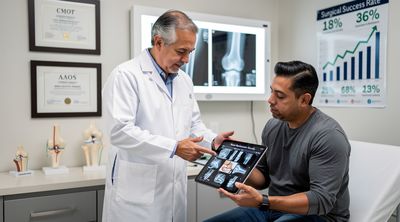
Look for board certification from respected organizations. The Mexican Council of Orthopedics and Traumatology (CMOT) certifies qualified surgeons who meet rigorous training standards. Many top Mexican orthopedic surgeons also hold memberships in international organizations like the American Academy of Orthopaedic Surgeons (AAOS).
Experience matters tremendously in orthopedic surgery. Seek surgeons who have performed thousands of knee replacements. For example, Dr. Jesús Raúl Arjona Alcocer in Cancun has treated over 17,000 patients throughout his career. Dr. Maximilian Greig in Puerto Vallarta brings over 25 years of specialized experience to every procedure.
Hospital accreditation provides objective quality verification. Joint Commission International (JCI) accreditation is the gold standard, representing the same rigorous standards applied to top American hospitals. ISO certifications and COFEPRIS approval (Mexico's equivalent to the FDA) also indicate serious commitment to quality and safety.
Top facilities maintain success rates between 90-99%, with complication rates under 2%. These statistics match or exceed what you'd find at leading American hospitals.
Galenia Hospital in Cancun holds JCI accreditation, while Hospital de la Familia in Mexicali maintains GHC and ISO certifications.
Patient reviews and video testimonials provide real-world insight. Watch for consistency in feedback about communication, care quality, and outcomes. Recent reviews matter more than older ones, as hospital quality can change over time.
Understanding Different Types of Knee Replacements
Total knee replacement is the most common type of surgery for severe knee arthritis. The procedure replaces the entire knee joint surface with metal and plastic components. Surgery typically takes 1.5 to 3 hours, and research shows that 82% of total knee implants remain functional for at least 25 years.
Partial knee replacement addresses damage to only one part of the knee. This less invasive procedure uses smaller incisions and preserves more of your natural knee structure. Recovery is faster, often just 2-4 weeks compared to the longer timeline for total replacement. However, you must be a suitable candidate based on your specific knee damage pattern.
Robotic-arm assisted surgery represents the cutting edge of knee replacement technology. The robotic system helps your surgeon achieve greater precision in implant positioning, potentially reducing wear and the need for revision surgery down the road. Puebla in Mexico offers this advanced option for about $11,000, still a fraction of US pricing for robotic procedures.
The appropriate type of surgery depends on your specific condition, activity level, and long-term goals. Your consultation with the surgeon will determine which approach offers the best outcomes for your situation.
What to Expect: The Knee Surgery and Recovery Timeline
Understanding the typical timeline helps you plan time off work and arrange for help during recovery.
Here's a standard nine-day itinerary:
Day 1: You arrive in Mexico, meet your surgical team, and complete pre-operative testing. Blood work, final X-rays or imaging, and your consultation happen on this day.
Day 2: Surgery day. The knee arthroplasty procedure takes approximately two hours. You'll wake up in recovery and then move to your hospital room.
Days 3-4: Hospital recovery under medical supervision. Physical therapy begins, helping you learn how to move safely with your new knee joint. Pain management keeps you comfortable.
Days 5-7: You transition to a hotel for continued rest. Many facilities have recovery accommodations nearby. You'll continue basic exercises and movement.
Day 8: Final post-operative check-up with your surgeon. They'll assess your healing, provide instructions for continued recovery, and clear you for travel.
Day 9: You're medically cleared to fly home and continue your recovery there.
Most patients walk with crutches or a walker within two weeks. Post-operative guidelines emphasize the importance of physical therapy in achieving the best results.
Partial recovery takes 4-6 weeks, during which you'll gradually increase activity levels. Return to low-impact activities like swimming or cycling often happens around this timeframe.
Full recovery with complete mobility and strength typically requires 3-6 months of consistent physical therapy and exercise. Patience during this phase pays dividends in long-term function.
Just as patients travel to Mexico for knee procedures, many also seek IVF treatment or hysterectomy, demonstrating the broad scope of medical tourism options available.
Frequently Asked Questions about Knee Replacement in Mexico
Is knee replacement surgery in Mexico safe?
Yes, when you choose JCI-accredited hospitals and board-certified surgeons. Top Mexican facilities report complication rates under 2%, matching US standards. They use the same FDA-approved implants and follow identical surgical protocols as American hospitals.
Will my insurance cover knee replacement in Mexico?
Most US insurance plans don't cover procedures performed outside the country. However, some employer-sponsored plans and health-sharing ministries are beginning to offer medical tourism benefits due to the substantial cost savings. Contact your insurance provider to ask about out-of-network international coverage options.
How long should I stay in Mexico after surgery?
Plan for at least 8-10 days. This includes pre-operative preparation, the surgery itself, initial hospital recovery, and a post-operative check-up before you're cleared to fly home. Rushing recovery can compromise your outcome.
What if I need revision surgery later?
Reputable hospitals provide warranties or guarantees for their work, typically covering complications within the first 30-90 days. For later issues, you may need to return to Mexico or seek care in the US. Discuss warranty terms before committing to a facility.